
 en
en TR
TR  SK
SK  ITA
ITA  FR
FR  DE
DE  ES
ES  BG
BG FUE Hair Transplant: A Clinical Guide to Follicular Unit Excision
The FUE technique — follicular unit excision — removes hair follicles one at a time from the safe donor zone at the back and sides of the head, using micro punches of 0.7–1.0 mm, and places them into thinning or bald areas. It leaves no linear scar. A standard session at Hair of Istanbul transfers 3,000–5,000 grafts over 6–8 hours under local anaesthesia, and the final result is judged at 12 months.
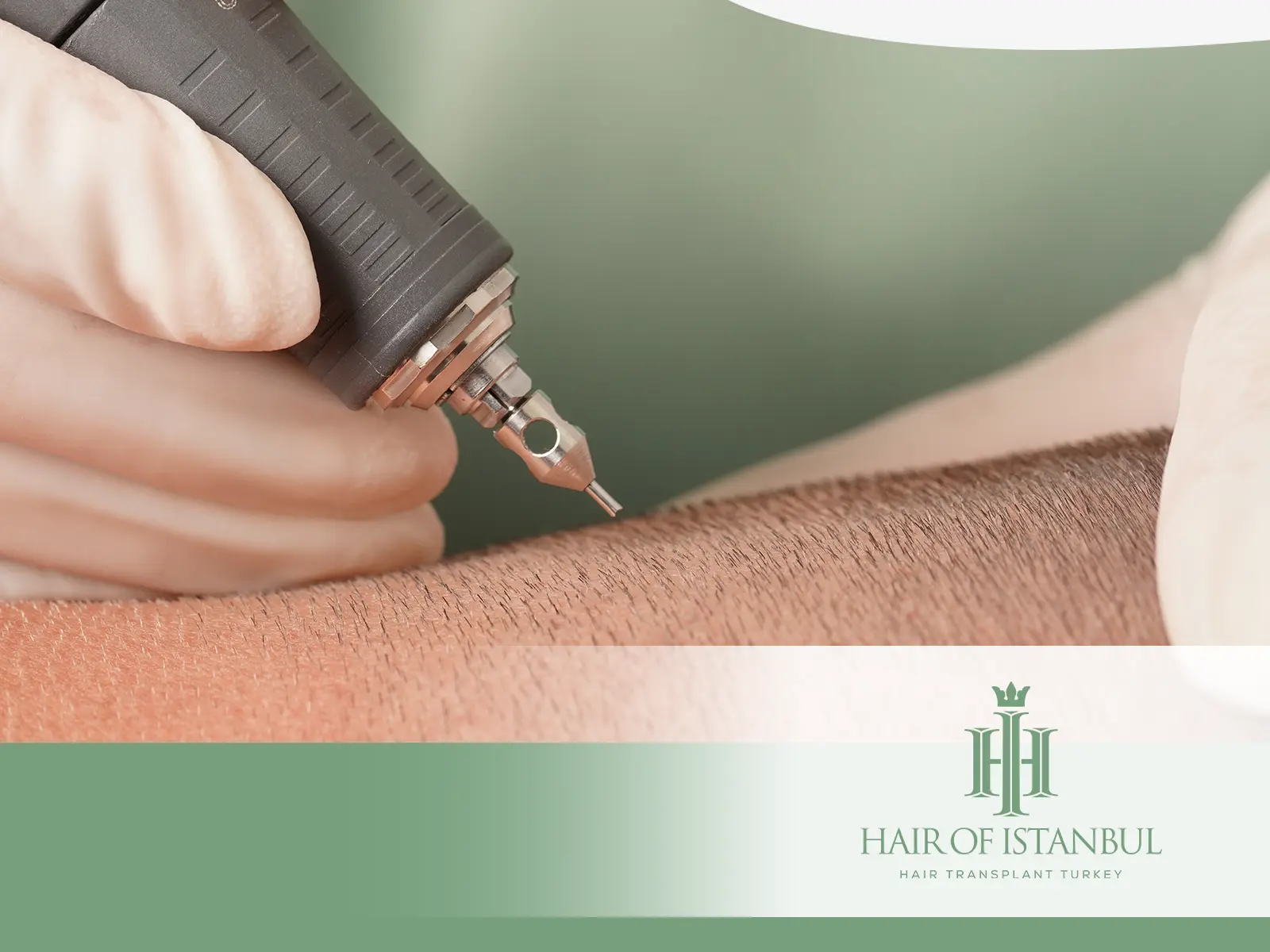
This page explains the FUE technique the way it is actually planned and carried out at Hair of Istanbul: the measurements taken before a date is agreed, the numerical limits that protect your donor area for life, and the parameters that decide whether transplanted follicles survive. More than 3,000 FUE procedures were carried out at our Istanbul clinic in 2024–2025.
It is written for two readers — the patient who wants to know exactly what will happen to their scalp, and the clinician who wants to see the parameters behind the outcome.
- What is the FUE technique?
- FUE, Sapphire, DHI and FUT compared
- Are you a suitable candidate?
- Medical screening before your date
- Planning: measuring before deciding
- Key clinical parameters
- Donor harvesting
- Graft preservation
- Recipient site design
- Anaesthesia and comfort
- Sterility and infection control
- Quality control and records
- Risks and how they are managed
- Recovery: the first 30 days
- When you will see results
- Cost
- Frequently asked questions
- References
What is the FUE technique?
The FUE technique is a hair transplant method in which follicular units are excised individually from the safe donor zone with a micro punch, then placed into thinning or bald areas. No strip of skin is removed and no line of stitches is needed, so there is no linear scar.
Hair does not grow as isolated strands. It grows in natural clusters of one to four hairs called follicular units, together with their sebaceous glands and erector muscle. FUE removes those units intact, which is why the result can look like hair that was always there.
The term is follicular unit excision rather than “extraction”. The change in wording, adopted by the International Society of Hair Restoration Surgery, reflects what the procedure actually is: a cut-and-remove step, not a simple pull.
One honest qualification: FUE is not scar-free. It leaves pinpoint dot marks in the donor area, roughly the diameter of the punch used. In most people these are difficult to see with the naked eye once the hair grows back, but they exist, and they matter if you intend to wear your hair very short.
FUE, Sapphire, DHI and FUT compared
All modern techniques remove follicles the same way. What differs is how the recipient sites are opened and how grafts are placed. The choice is driven by your donor characteristics, the area being treated and the density target — not by price.
| Method | How sites are made | Best suited to | Consider |
|---|---|---|---|
| FUE | Micro punch harvest, steel blade incisions | Large sessions, broad coverage | The established baseline technique |
| Sapphire FUE | Sapphire-tipped blades, finer channels | Dense packing, reduced channel trauma | Site geometry is highly controllable |
| DHI | Implanter pen; site and placement in one motion | Hairline detail, unshaven work, eyebrows | Slower, so session sizes are smaller |
| SLIT | Pre-made slits, manual placement | Angle and direction control on the crown | Often combined with FUE |
| FUT | Strip harvest, sutured closure | Rarely indicated today | Leaves a linear donor scar |
Most plans combine methods — for example DHI along the hairline for detail and Sapphire FUE behind it for volume. Read more on how DHI compares.
Why FUE replaced FUT in routine practice
- No linear scar — only pinpoint dot marks that hide under short hair.
- Faster recovery — most patients return to desk work within 3–5 days.
- Less post-operative discomfort — no strip excision means no deep tissue closure.
- Compatible with short hairstyles — no visible line if you clip your hair down.
Are you a suitable candidate?
Suitability is decided by measurement, not by photographs alone. Before any FUE procedure at Hair of Istanbul, a pre-operative follicle analysis is carried out using densitometry and trichoscopy. It records:
- Follicular unit density in the donor area, counted per cm²
- Average hairs per follicular unit — typically 2.0 to 2.3
- Hair shaft thickness in microns
- A miniaturisation map — areas where follicles are weakening but not yet lost
- Hair-to-skin colour contrast, which changes how much coverage a given density achieves
Donor density in adults usually falls between 60 and 100 FU/cm², but it varies considerably between individuals. These measurements answer three questions with figures rather than estimates: how many grafts can safely be harvested, what density will be implanted and where, and how the donor area will be preserved for any future session.
The safe donor zone is mapped to stay outside regions that are themselves susceptible to androgenetic loss — particularly the lower nape and the upper lateral areas. Harvesting outside that boundary can look acceptable at six months and visibly thin at three years.
A realistic target, explained
The aim is not to reproduce your original density hair for hair. It is to reach the optical fullness threshold — the point at which the scalp reads as covered. For most people that threshold is reached at roughly half the original density, because hair shafts overlap and shadow the skin beneath. Understanding this is what separates a satisfied patient from a disappointed one.
Good candidates typically have
- A hair loss pattern that has been stable for at least 12 months
- Donor density above 60 FU/cm²
- No active scalp disease
- Expectations that match what the donor area can supply
- Age generally 18 to 60, with younger patients assessed particularly carefully because the loss pattern is not yet settled
When we advise against FUE
A clinic that accepts every enquiry is not assessing anyone. These are the situations in which we postpone the procedure or advise against it:
- Diffuse unpatterned alopecia — where the donor area is itself miniaturising, transplanted hair will thin along with everything else.
- Donor density below roughly 50–55 FU/cm² with a large area to cover — the arithmetic does not work, and harvesting anyway damages the donor permanently.
- Active scalp disease — dermatitis, folliculitis, psoriasis or fungal infection must be treated and settled first.
- Unstable or rapidly progressing loss, particularly in men under 25, where medical treatment should be established before surgery is considered.
- Active cicatricial (scarring) alopecia — the disease must be documented as inactive, usually for 12 months or more, before grafting is discussed.
- Uncontrolled systemic disease, or a cardiac or coagulation problem that pre-operative review shows to be unsafe.
- A request for a “maximum graft” figure the donor cannot support — over-harvesting produces a moth-eaten donor within one to two years. We will not do it.
- Expectations that cannot be met — a teenage hairline at fifty, or a fixed density promise that no clinic can honestly make.
If you are not a suitable candidate, we will tell you so before you book travel, not after.
Medical screening before your date
Every patient is screened before a surgical date is confirmed. This is a clinical requirement, not an optional extra, and it is the step most often skipped elsewhere.
| Assessment | What it checks | Reviewed by |
|---|---|---|
| Full blood panel | Full blood count, clotting profile, infectious screen, ferritin, thyroid function | Medical review |
| ECG | Cardiac rhythm and conduction | Cardiology |
| Anaesthetic review | Allergies, medication interactions, anticoagulant management | Anaesthesiology |
| Follicle and donor analysis | Donor density, hair calibre, scalp condition, miniaturisation | Surgical planning |
| Hairline design | Facial proportions, age-appropriate placement, long-term balance | Surgical planning |
Where screening identifies a contraindication, the procedure is postponed or advised against.
Several findings change the protocol rather than cancelling it. Anticoagulant or antiplatelet use, diabetes, hypertension, a history of keloid formation, and heavy smoking each alter how the day is planned — bleeding management, adrenaline dosing, session length and healing expectations are adjusted accordingly. Anticoagulant management is agreed between cardiology and anaesthesiology before your date is confirmed; you should never stop a prescribed medication on your own initiative.
Standard-angle photographs are recorded before the procedure, and the informed consent process is completed with enough time to ask questions in your own language.
Planning: measuring before deciding
Planning begins with the Norwood classification, hair shaft thickness and wave pattern, hair-to-skin colour contrast, and the distribution of miniaturisation.
Densitometric readings are taken from at least three points along the occipital, mastoid and temporal lines. FU/cm² and average hairs per FU are recorded and documented photographically. The recipient area is then measured in square centimetres and a target density map is drawn for each sub-region.
How the graft figure is calculated
The arithmetic is shared with you openly:
Worked example. An area of 80 cm² to cover, at a target of 35 FU/cm²:
80 cm² × 35 FU/cm² = 2,800 follicular units
At an average of 2 hairs per unit, that is approximately 5,600 hairs transferred.
The figure is then checked against what your donor area can give up without visible thinning. Where the two disagree, the donor limit governs — always. If the numbers do not support the coverage you want in one session, we say so and plan in stages instead.
Key clinical parameters
These are the ranges followed at Hair of Istanbul. They protect the outcome and the donor area at the same time.
Donor harvesting limits, by donor profile
| Donor profile | Safe single-pass harvest | Residual density to preserve |
|---|---|---|
| Thin shaft or limited donor capacity | 10–15 FU/cm² | ≥ 45 FU/cm² |
| Average donor (65–80 FU/cm² baseline) | 15–20 FU/cm² | ≥ 40–50 FU/cm² |
| Thick shaft with favourable tissue | 20–25 FU/cm², selected cases | ≥ 40 FU/cm² |
Recipient density targets, by zone
| Zone | Target density | Graft type | Angle |
|---|---|---|---|
| Frontal hairline, first 1–2 cm | 30–40 FU/cm² | Single-hair units only | 10–15° |
| Frontal zone behind the hairline | 35–45 FU/cm² | Double and triple units | 20–30° |
| Mid-scalp | 30–35 FU/cm² | Double and triple units | 30–40° |
| Crown / vertex | 25–35 FU/cm² | Mixed, whorl-oriented | Follows the natural whorl axis |
| Dense packing, selected beds only | 45–55 FU/cm² | Mixed | Zone-dependent |
Where the zone target and the donor limit disagree, the lower figure governs. Dense packing above 45 FU/cm² is used only where vascularisation, shaft thickness and tissue conditions are assessed as suitable and monitored throughout.
Converting density into hair count
At an average of 2.0–2.3 hairs per follicular unit, a target of 35 FU/cm² delivers roughly 70–80 hairs per cm². The actual hairs-per-unit figure is measured for each patient rather than assumed — it is one of the largest sources of error in graft estimates given over the internet.
Why these particular numbers
- 60–100 FU/cm² donor baseline — consistent with multi-centre densitometry across ethnic groups.
- 15–20 FU/cm² single-pass harvest — preserves donor appearance in most average donors without visible thinning.
- 30–40 FU/cm² recipient target — balances growth rate against natural appearance. Higher densities compete for the same blood supply.
- Approximately 4 °C storage — slows metabolism without ice damage. Room temperature is adequate for short waits.
- Under 3 hours out of the body — the strongest single variable in graft viability. Beyond this, survival begins to decline measurably.
Donor harvesting
The punch is advanced parallel to the hair exit angle, with a depth guard controlling penetration. The sequence is scoring → dissection → extraction. Manual and motorised systems are both used; sharp punches, dull punches and blunt-tip systems each shift the balance between transection risk and buried grafts.
Punch selection
The 0.8–1.0 mm band is the most commonly used range in current practice, and 0.9 mm is a typical starting point for scalp hair. Transection rates tend to fall as diameter increases, but wound size and vascular trauma rise with it. Selection therefore weighs three things together: hair shaft thickness and curl pattern, skin elasticity and scalp tissue characteristics, and the measured transection performance with that punch on that scalp.
Transection rate
Transection — follicles damaged during removal — is counted live during the procedure rather than estimated afterwards. The working target is below 5%, and always below 10%, reviewed every 30 minutes during the donor phase. A rising rate triggers a change in punch, angle or depth, not a decision to press on.
Distribution pattern
Harvesting is distributed in a mosaic pattern across the donor zone rather than taken row by row or band by band. Consecutive harvesting from the same row is the single most common preventable error we see in revision cases arriving from other clinics — it produces visible striping that no later procedure can fully correct.
Why depth matters more than it sounds. Advancing the punch deeper than necessary raises dermal temperature and triggers ischaemia–reperfusion stress in the follicle. A 0.1 mm difference in depth can be the difference between an intact graft and a damaged one.
Graft preservation
Graft survival is decided largely in the interval between removal and placement. Three principles, in order of importance: keep the time out of the body short, keep grafts continuously moist, and hold the correct temperature–solution balance.
- Short waits (under one hour) — isotonic 0.9% sodium chloride or Lactated Ringer’s is sufficient, at room temperature.
- Prolonged waits — grafts are held cold at approximately 4–10 °C without freezing.
- Extended cases — hypothermic storage solutions with published supporting data may be used, though their effect varies with case conditions. They supplement good technique; they do not replace it.
Dehydration can reduce viability within tens of minutes, so grafts on the working surface are misted with saline, gauze is refreshed frequently, and grafts are never left exposed. A multiple-dish rotation keeps one tray in the field while the others remain cold, and grafts are brought forward in small bundles.
Cold chain management
The aim is a stable 2–8 °C in the graft tray. This requires a lidded insulated container, a temperature probe or data logger, two rotating sets of gel packs, a supply of preservation solution, and a rack that prevents direct ice contact with the graft container.
Temperature is recorded every 15–30 minutes. Above 8 °C the gel pack is replaced; below 1–2 °C ice contact is reduced to avoid freezing injury. Under typical room conditions a change every two to three hours is usually enough — but the decision is made on the measured temperature, not on the clock, because lid-opening frequency and ambient temperature vary from day to day.
Recipient site design
The recipient sites determine what the result looks like. The follicles are the same either way; the angle, direction and distribution of the incisions are what make hair read as natural or as a transplant.
Angle and direction
Native hair leaves the scalp at a specific angle that changes by zone: most acute at the frontal hairline at 10–15°, rising to 30–40° through the mid-scalp, and following the whorl axis at the vertex. Each site is opened to match. More acute angles allow shallower penetration for the same channel length, which helps protect the deep vascular plexus.
Site geometry
Coronal slit orientation and semi-conical blade profiles reduce tissue injury and lower the risk of popping — grafts lifting out of their bed after placement. The slit is planned about 0.1–0.2 mm narrower than the graft and left slightly shorter than the graft length, so the follicle seats firmly rather than sitting proud or sinking.
Distribution
Single-hair units are used across the first one to two centimetres of the hairline; nothing else produces a soft, irregular leading edge. Double and triple units go behind them, where they create the impression of density. Micro-irregularity and macro-irregularity are built into the line deliberately — a perfectly even hairline is the clearest sign of a poorly designed one.
Placement
Grafts are handled by the surrounding tissue, never by the bulb, and the field is kept continuously moist with a saline mist. Placement is either into pre-made slits with fine forceps, or with an implanter pen where the target density and tissue conditions favour it. Slit creation and placement proceed on a fresh-slit, fresh-graft cycle rather than opening the whole field at once, which shortens the time any individual site stays open.
Anaesthesia and comfort
An FUE procedure is performed under local anaesthesia. You are awake throughout, and no general anaesthesia is required for a standard session.
Local anaesthetic is administered and your vital signs are monitored continuously by a specialist anaesthesiologist who is present for the whole procedure. Tumescent infiltration follows: it provides comfort, reduces bleeding and raises tissue turgor, which makes harvesting cleaner. Tumescent pressure is kept to what is needed and no more, adrenaline-containing solutions are dosed carefully, and tissue ischaemia times are tracked.
Anxiety is managed without over-sedation. In patients prone to pain or vasovagal responses, positioning, warming, oral fluids and short scheduled breaks are planned in advance rather than improvised on the day. You will feel the anaesthetic injections; after that, pressure and movement rather than pain.
Sterility and infection control
The chain is straightforward and non-negotiable: full instrument sterilisation, lot tracking of single-use consumables, surgical drapes changed between stages, and instrument and consumable counts before and after the procedure. Operating areas are cleaned and disinfected to Republic of Türkiye Ministry of Health protocols, and records are kept audit-ready.
Hair of Istanbul operates under Ministry of Health authorisation. Licensing is verifiable — it is not a badge on a website.
Quality control and records
Outcomes are measured rather than assumed. The following are recorded for every case:
| Measure | Target | Recorded |
|---|---|---|
| Transection rate | Below 5%, always below 10% | Every 30 minutes, donor phase |
| Graft tray temperature | 2–8 °C | Every 15–30 minutes |
| Average time out of body | Under 2–3 hours | Per bundle |
| Graft composition (ATE) | Measured, not assumed | Counted by lot |
| Photographic documentation | Standard angles | Day 0, months 3, 6, 12 |
| Trichoscopy follow-up | — | Months 6 and 12 |
At the close of every procedure the total graft and hair counts, the average hairs per unit, average time out of body and any complication notes are entered into the medical record. Post-operative instructions are given verbally and in writing in your own language.
“The parameters on this page are not marketing figures. They are the numbers we record during your procedure and check against your photographs at months six and twelve. That is the only way a clinic can know its results rather than believe in them.”
— Dr Mahmut Satekin, Medical Aesthetics Physician, Hair of Istanbul
Risks and how they are managed
Every surgical procedure carries risk. With FUE the recognised risks are swelling, bleeding, infection, folliculitis, temporary numbness, poor graft survival and donor thinning. Most are transient; donor thinning is not.
| Risk | Typical course | How it is reduced |
|---|---|---|
| Forehead swelling | Days 2–5, resolves without treatment | Head elevation, controlled tumescent volume, cold compress to the forehead only |
| Bleeding | Minor, during the procedure | Careful adrenaline dosing, anticoagulant review before the date is set |
| Folliculitis | Weeks 4–12, usually self-limiting | Washing protocol, early review of any persistent pustule |
| Infection | Uncommon | Sterile chain, single-use consumables, aftercare compliance |
| Temporary numbness | Weeks to a few months | Depth control during harvesting |
| Poor graft survival | Judged at 12 months | Short time out of body, continuous moisture, temperature control, transection monitoring |
| Donor thinning | Permanent if it occurs | Mosaic distribution, safe-zone boundaries, harvest limits by donor profile |
Two points are worth stating plainly. First, no clinic can promise a specific density or a fixed survival figure — biology varies between patients, and anyone who does promise one is selling rather than assessing. Second, hair loss continues after a transplant. A result that looks correct at twelve months can look unbalanced at five years if the native hair around it was not considered in the plan. That is why age-appropriate design and long-term donor preservation matter more than the graft number.
Recovery: the first 30 days
| Period | What to expect |
|---|---|
| Day 0 | Donor area dressed. Medication issued. Aftercare explained in your own language. |
| Day 1 | Return to the clinic. Dressing renewed, donor and recipient areas examined. |
| Days 2–3 | First wash carried out at the clinic. Forehead swelling is common and settles. Sleep on your back, head elevated. |
| Days 4–10 | Crusting forms and clears gradually with the prescribed washing routine. Redness begins to fade. |
| Days 10–14 | Controlled crust removal completed. Most patients return to routine activity; light exercise can usually resume. |
| Weeks 3–6 | Transplanted hairs shed. This is expected and is not a sign of failure — the roots remain. |
In the first 24 hours the recipient area is kept lightly moist and free of trauma. Cold compresses are applied to the forehead only, never to the grafts, in 10–15 minute applications separated by 45–60 minute intervals. Full day-by-day instructions are in our aftercare guide.
When you will see results
| Timepoint | What is happening |
|---|---|
| Weeks 2–4 | Transplanted hairs shed. Normal and expected. |
| Months 3–4 | New growth begins. Early hair is fine and may look uneven. |
| Months 6–8 | Density becomes clearly visible. Roughly 60–70% of the final appearance. |
| Months 12 | The result you should judge. Shafts have thickened and matured. |
| Months 12–15 | Final refinement, particularly in the crown and in curly hair types. |
Timelines vary between patients. Where a second session is being considered, we ask for a full 12 months before assessing.
Preserving your native hair
A transplant relocates hair; it does not stop hair loss. In suitable patients, long-term medical therapy such as finasteride or topical minoxidil is considered to preserve the native hair around and behind the transplanted area. Whether either is appropriate for you — and whether the known side effect profile is acceptable in your case — is a clinical decision made at consultation, not a default recommendation.
The alternative is predictable: transplanted hair holds while surrounding native hair continues to thin, and the result begins to look disconnected within a few years.
Cost
An FUE hair transplant at Hair of Istanbul costs between €4,000 and €5,000 as an all-inclusive package. Pricing is set by graft count, not by technique — there is no surcharge for DHI, Sapphire or SLIT.
| Graft range | Package | Typical Norwood stage |
|---|---|---|
| 1,500 – 2,500 grafts | €4,000 | II – III |
| 2,500 – 3,500 grafts | €4,500 | IV – V |
| 3,500+ grafts | €5,000 | V – VI |
All-inclusive: pre-operative blood tests, ECG and medical review; the procedure using DHI, Sapphire or SLIT as clinically appropriate; medication, one PRP session and aftercare products; accommodation; airport and clinic transfers; first wash, aftercare briefing and follow-up. See the full 2026 price list.
Frequently asked questions
How long does an FUE procedure take?
A standard session of 3,000–5,000 grafts takes 6–8 hours in one day. The donor phase typically runs 2–3 hours, graft sorting about an hour, and recipient preparation and placement 3–4 hours. Cases above 5,000 grafts may be split across two consecutive days.
How many follicular units can be harvested and implanted per square centimetre?
For an average donor, 15–20 FU/cm² can be harvested safely in a single pass while preserving at least 40–50 FU/cm² of residual density. On the recipient side, 30–40 FU/cm² suits most cases; 45–55 FU/cm² is reserved for selected beds where vascularisation and tissue conditions allow. At 2 hairs per unit, 35 FU/cm² equates to roughly 70 hairs per cm².
Is the FUE technique painful?
The anaesthetic injections are felt. After that, most patients describe pressure and movement rather than pain. Local anaesthesia is administered and monitored by a specialist anaesthesiologist throughout the procedure, and top-up doses are given as the session progresses.
Does FUE leave scars?
Not a linear scar. It leaves pinpoint dot marks in the donor area, approximately the diameter of the punch used. In most people these are difficult to see once hair regrows, but they are permanent and become more apparent if the hair is clipped very short.
At what temperature should grafts be held?
For short waits under an hour the difference between room temperature and cold storage is limited. For longer waits, approximately 4 °C is the target, with 2–8 °C as the practical working band. The governing rules are continuous moisture and the shortest possible time out of the body.
What transection rate is acceptable in FUE?
Below 5% is the working target and below 10% the limit. It is counted live during the donor phase and reviewed every 30 minutes. A rising rate is a signal to change punch diameter, angle or depth.
When will I see the final result of an FUE hair transplant?
Transplanted hairs shed at weeks 2–4, which is normal. New growth begins at months 3–4, density becomes clearly visible at months 6–8, and the result you should judge is at 12 months. Curly hair and crown work can take up to 15 months to settle.
How many grafts will I need?
It depends on the area to be covered and what your donor area can safely supply. Most patients with a receding hairline and mid-scalp thinning fall between 2,500 and 3,500 grafts. The figure is calculated from measured area and target density, then checked against donor capacity — the lower of the two governs.
Is FUE suitable for women?
Yes, with appropriate indication. Female hair loss is more often diffuse than patterned, so candidate assessment is more nuanced and the underlying cause must be identified first. An unshaven or partially shaved approach can be planned where visible donor trimming is not acceptable. See our women’s hair transplant page.
What is the difference between FUE and DHI?
Both remove follicles the same way. FUE places grafts with fine forceps into pre-made slits; DHI uses an implanter pen that creates the site and places the graft in one motion. DHI offers advantages in hairline detail and unshaven work, but sessions are slower and therefore smaller. Most plans combine the two.
What is the difference between FUE and Sapphire FUE?
Only the blade used to open the recipient sites. Sapphire-tipped blades produce finer, more uniform channels than steel, which helps when packing density. The harvesting method is identical, and there is no price difference at Hair of Istanbul.
Can FUE correct a previous hair transplant?
Often, yes — depending on remaining donor capacity, the extent of scarring and how the original grafts were placed. Revision work is more complex than a first procedure and is assessed individually. We ask for a full 12 months after the previous procedure before assessing. See revision hair transplant.
Will transplanted hair fall out later?
Follicles taken from the safe donor zone retain their resistance to the hormonal process that causes pattern loss, so transplanted hair is generally permanent. Native hair around it continues to thin, however, which is why long-term planning and, where appropriate, medical therapy matter.
Can I have FUE without shaving my head?
Partially. Unshaven and partially shaved approaches are possible for smaller sessions and are used routinely for female patients. For large sessions of 3,000 grafts or more, shaving the donor area is generally necessary for accurate angle and depth control.
How soon can I fly home after an FUE hair transplant?
Most patients stay three days in Istanbul: screening and planning on day one, the procedure on day two, first wash and aftercare briefing on day three. Flying on day three is routine. Where you travel on day two, the washing technique is demonstrated in person and written instructions are provided.
What happens if my blood tests or ECG show a problem?
The procedure is postponed, or advised against. Depending on the finding you may be asked to see your own physician first, or the protocol may simply be adjusted — anticoagulant management, for example, changes the plan rather than cancelling it.
How much does an FUE hair transplant cost in Turkey?
At Hair of Istanbul an FUE hair transplant costs between €4,000 and €5,000 as an all-inclusive package. Pricing is set by graft count, not by technique, so there is no surcharge for DHI, Sapphire or SLIT: 1,500–2,500 grafts is €4,000, 2,500–3,500 grafts is €4,500 and 3,500+ grafts is €5,000.
References
- Rassman WR, Bernstein RM, McClellan R, Jones R, Worton E, Uyttendaele H. Follicular unit extraction: minimally invasive surgery for hair transplantation. Dermatologic Surgery, 2002.
- Bernstein RM, Rassman WM. Follicular unit transplantation. Dermatologic Clinics, 2005.
- Jimenez F, Ruifernández JM. Distribution of human hair in follicular units: a mathematical model for estimating donor size in follicular unit transplantation. Dermatologic Surgery, 1999.
- Cole JP. An analysis of follicular punches, mechanics and dynamics in follicular unit extraction. Facial Plastic Surgery Clinics of North America, 2013.
- Parsley WM, Perez-Meza D. Review of factors affecting the growth and survival of follicular grafts. Journal of Cutaneous and Aesthetic Surgery, 2010.
- Limmer BL. Elliptical donor stereoscopically assisted dissection and its role in follicular unit transplantation. Dermatologic Surgery, 1994.
- Norwood OT. Male pattern baldness: classification and incidence. Southern Medical Journal, 1975.
- International Society of Hair Restoration Surgery. Practice Census and terminology guidance on follicular unit excision.
Find out whether FUE is right for you
Send photographs of your hairline, crown and donor area and we will come back to you with an assessment of your donor capacity and an indicative graft range — including an honest answer if we think you should wait, or not proceed at all.
Request an assessment · Estimate your graft requirement · 2026 price list
Medically reviewed by Dr Mahmut Satekin, Medical Aesthetics Physician at Hair of Istanbul. Last reviewed August 2026. This page is general information about a medical procedure and does not replace individual assessment. Suitability, technique and expected outcome are determined after examination.
