
 en
en TR
TR  SK
SK  ITA
ITA  FR
FR  DE
DE  ES
ES  BG
BG DHI Hair Transplant: A Clinical Guide to Direct Hair Implantation
A DHI hair transplant — direct hair implantation — places each follicular unit with a sharp-tipped implanter pen that creates the recipient site and seats the graft in one motion. It is a placement technique, not a way of harvesting: the follicles are still removed by FUE. Its advantages are angle, direction and depth control at the hairline, work among existing hair without cutting it, and procedures without shaving. Sessions run slower than forceps placement, so a typical DHI day transfers 2,000–3,500 grafts over 6–8 hours.
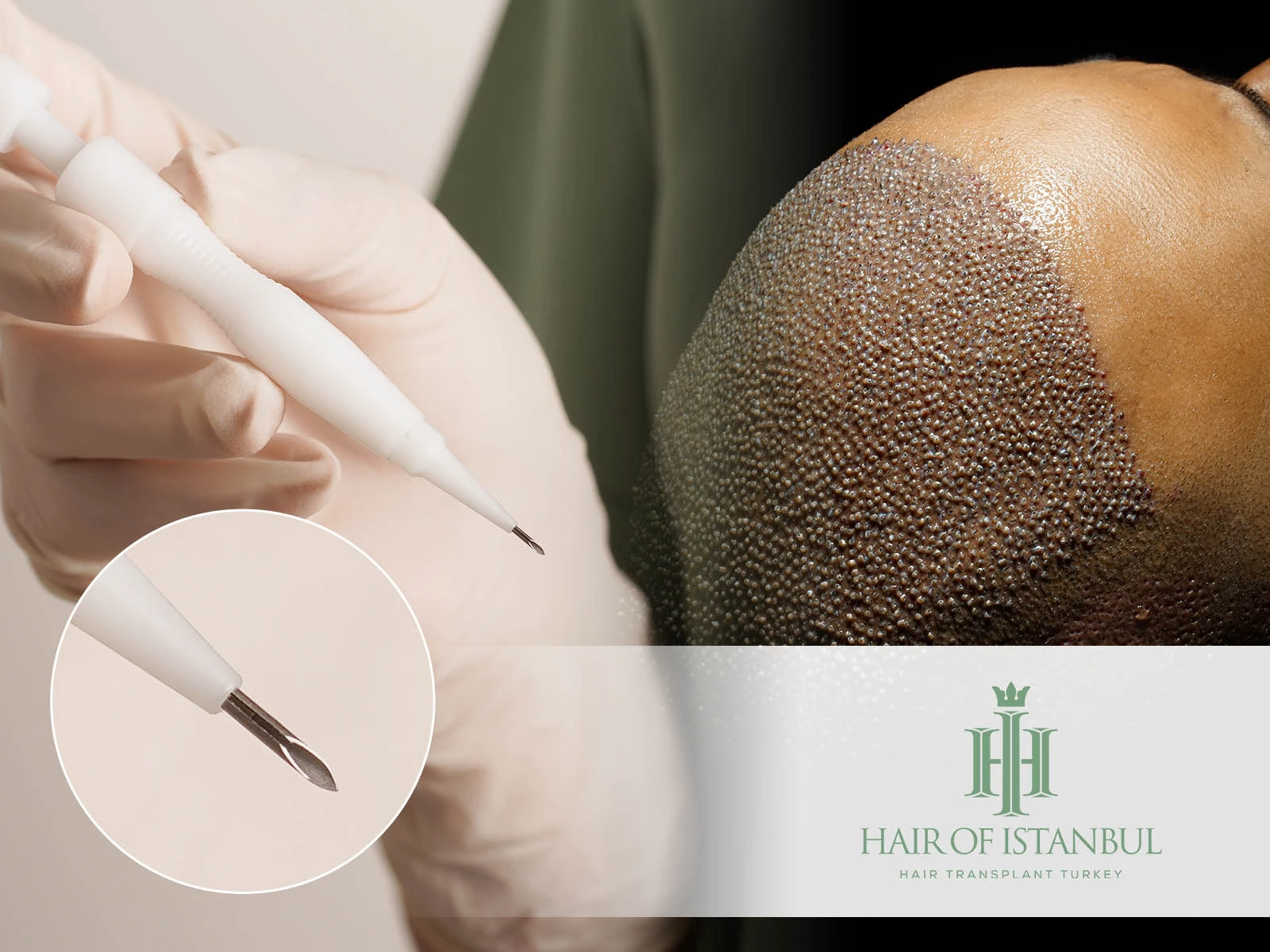
This page explains what a DHI hair transplant actually involves, where the technique genuinely helps, where it does not, and what the published evidence supports. It is deliberately specific about the parameters that decide the outcome — tip diameter, depth, angle, bleeding control — because those are what separate a natural hairline from an obvious one.
If you are looking for how follicles are removed, donor limits and graft preservation, that is covered on our FUE technique page. The two pages are deliberately different: extraction there, placement here.
- What is the DHI technique?
- Why DHI is not a separate method
- DHI, Sapphire FUE and SLIT compared
- Where DHI makes a real difference
- Unshaven and partially shaved DHI
- Medical screening before your date
- How a DHI procedure works
- Implanter selection: tip diameter
- Angle, direction and depth
- Dense packing among existing hair
- Bleeding and popping
- What the evidence shows
- Risks and how they are managed
- Recovery and results
- Cost
- Frequently asked questions
- References
What is the DHI technique?
The DHI technique is a graft placement method in which a sharp-tipped implanter pen creates the recipient site and delivers the follicular unit in the same movement. There is no separate incision step and no forceps.
The instrument is a hollow needle mounted in a pen-shaped handle with a plunger. A follicular unit is loaded into the lumen, the needle is introduced into the scalp at the planned angle and depth, the plunger releases the graft, and the needle is withdrawn. Because the follicle travels inside the needle, the bulb is never gripped.
The approach originated in Korea in the 1990s, where the Choi implanter was developed for placing single-hair grafts with controlled angle and depth into the hairline, eyebrows and eyelashes. It suited straight, thick Asian hair particularly well. As FUE spread through the 2000s, implanter placement was adopted more widely.
Why DHI is not a separate method
This matters, and most clinics avoid saying it.
DHI is often marketed as a distinct hair transplant “method”. It is not. The follicles are still harvested by FUE, one at a time, with a micro punch. What changes is only the final step — how the graft enters the scalp. The International Society of Hair Restoration Surgery is explicit that DHI describes an implantation workflow and the use of a sharp implanter, and should not be presented as a standalone method.
What this means for you as a patient. If a clinic quotes you a higher price “because it is DHI”, you are paying extra for an instrument, not for a different operation. At Hair of Istanbul pricing is set by graft count. There is no surcharge for DHI, Sapphire or SLIT, and the technique is chosen on clinical grounds alone.
Saying this plainly costs us an upsell. It also happens to be true, and it is the reason the rest of this page can be specific rather than promotional.
DHI, Sapphire FUE and SLIT compared
All three describe how the recipient site is made and how the graft is placed. The harvest is identical in each.
| Method | How the site is made | How the graft is placed | Best suited to |
|---|---|---|---|
| DHI | Sharp implanter needle, at the moment of placement | Plunger releases the graft inside the needle | Hairline detail, unshaven work, densification among existing hair, eyebrows |
| Sapphire FUE | Sapphire-tipped blade, pre-made | Fine forceps into the open channel | Dense packing over larger areas |
| SLIT | Steel blade, pre-made slits | Fine forceps | Angle and direction control on the crown |
Most plans combine them — DHI along the frontal hairline where every graft is visible, Sapphire FUE behind it where volume matters more than individual placement. Read more about how follicles are harvested.
The honest trade-off
DHI gives finer control over each graft. It is also slower, which means fewer grafts in a working day and a longer procedure for the same coverage. For a Norwood V or VI needing broad coverage, spending the whole session on implanter placement usually serves the patient worse than combining methods. That is a planning decision, not a marketing one.
Where DHI makes a real difference
Four situations, where the instrument genuinely changes what is achievable:
1. The frontal hairline
The first one to two centimetres of the hairline are where a transplant is judged. Every graft there is a single-hair unit, placed at an acute 10–15° angle, and any that sits too deep, too shallow or at the wrong angle is visible for life. Because the implanter controls entry angle, direction and depth in a single controlled movement, it removes one source of variability at exactly the point where variability shows.
2. Densification among existing hair
When the target area still holds native hair — a thinning crown, a receding but not bald frontal zone — pre-made incisions risk transecting the follicles already there. A sharp implanter enters between existing hairs under direct vision, one graft at a time. This is the strongest indication for DHI and the one where the difference is least arguable.
3. Unshaven and partially shaved procedures
Placement between long existing hairs is far easier when the site is created and filled in one motion. It is the reason unshaven work is usually planned around DHI.
4. Eyebrows and small aesthetic units
Brow restoration demands very acute angles — often 5–15° to the skin — and single-hair grafts throughout. See our eyebrow transplant page for the detail.
When we do not recommend DHI
The instrument is not a universal upgrade. These are the situations in which a different approach serves you better, and we will say so:
- Very large sessions over broad areas — above roughly 3,500 grafts, implanter-only placement extends the day without improving the result. Combining methods is better for you.
- Bleed-prone scalps — because the incision and placement happen together, haemostasis is harder to control. Where bleeding is difficult, pre-made sites give a calmer field.
- Very thick or heavily curled grafts that do not pass cleanly through an implanter lumen without compression.
- Loose or highly elastic scalp tissue, where popping — neighbouring grafts lifting out of their beds — becomes difficult to control.
- Any case where DHI is being requested because it was advertised as superior. It is a placement technique. The evidence does not support paying more for it, and we do not charge more for it.
The same general contraindications apply as for any hair transplant: unstable hair loss, donor density too low for the area, active scalp disease, active scarring alopecia, uncontrolled systemic disease. These are set out in full on our FUE technique page.
Unshaven and partially shaved DHI
The recipient area can stay unshaven. The donor area usually cannot. That distinction is where most confusion sits.
| Approach | What is shaved | Practical limit | Typically suits |
|---|---|---|---|
| Fully unshaven | Nothing | Up to roughly 1,500 grafts | Small frontal work, women, patients who cannot show a shaved head |
| Partially shaved | A donor strip concealed under longer hair above it | Up to roughly 2,500–3,000 grafts | Most patients wanting discretion |
| Donor shaved only | Donor area, recipient left long | Full session size | Densification among existing hair |
Unshaven harvesting is slower and the transection rate is harder to keep low, which is why graft numbers are capped. Where the numbers do not work, we say so before you book travel rather than shaving your head on the day.
Medical screening before your date
The screening protocol is the same for every procedure at Hair of Istanbul, and it happens before a surgical date is confirmed: full blood panel, ECG reviewed by cardiology, anaesthetic assessment, densitometric donor analysis and hairline design. Where screening identifies a contraindication, the procedure is postponed or advised against.
Anticoagulant and antiplatelet use matters more in DHI than in most procedures, because simultaneous incision and placement makes bleeding harder to control. Management is agreed between cardiology and anaesthesiology before your date is set. Never stop a prescribed medication on your own initiative. The full screening table is on our FUE technique page.
How a DHI procedure works
| Stage | What happens | Typical duration |
|---|---|---|
| 1 · Design | Hairline drawn and agreed with you in person, density map set per zone | 45–60 min |
| 2 · Anaesthesia | Local anaesthetic and tumescent infiltration, monitoring throughout by a specialist anaesthesiologist | 20–30 min |
| 3 · Harvest | Follicular units excised by FUE with 0.7–1.0 mm micro punches | 2–3 hours |
| 4 · Sorting | Grafts classified by hair count, kept moist at 2–8 °C | ~1 hour |
| 5 · Loading and placement | Each unit loaded into the implanter lumen and placed at the planned angle, direction and depth | 3–4 hours |
| 6 · Dressing | Donor dressed, medication issued, aftercare explained in your own language | 20–30 min |
Grafts are loaded before they can dry and without pressure on the follicular bulb. Loading and placement run on a continuous cycle so that no unit waits longer than necessary — time out of the body remains the strongest single variable in graft survival.
Implanter selection: tip diameter
Tip diameter is matched to graft calibre, not chosen once for the whole case. A needle too wide leaves a loose graft and a larger wound; too narrow compresses the follicle on the way in. Several diameters are in use across a single procedure.
| Graft | Typical tip diameter | Where it is used |
|---|---|---|
| Single hair, fine calibre | 0.6–0.7 mm | Frontal hairline leading edge, eyebrows |
| Single to double hair | 0.8 mm | Behind the hairline, temporal points |
| Double to triple hair | 0.9 mm | Mid-scalp, frontal zone volume |
| Triple hair, thick calibre | 1.0 mm and above | Crown, coarse or curly hair |
Hair shaft thickness is measured at your pre-operative follicle analysis, so tip selection is based on your measured calibre rather than an assumption. Curl pattern also matters: coiled hair curves below the surface and needs a wider lumen for the same hair count.
Depth control
Depth stoppers are set for each zone. A graft placed too deep risks folliculitis, ingrown hairs and pitting; too shallow, and it dries out or lifts. The working target is for the follicular unit to sit level with the surrounding skin, with the epidermal portion just proud of it.
Angle, direction and depth
These three parameters decide whether the result reads as hair or as a transplant, and the implanter manages all three in one movement.
| Zone | Exit angle | Direction | Graft type |
|---|---|---|---|
| Frontal hairline, first 1–2 cm | 10–15° | Forward, with deliberate micro-irregularity | Single hair only |
| Frontal zone behind the hairline | 20–30° | Forward and slightly lateral | Double and triple |
| Mid-scalp | 30–40° | Follows native flow | Double and triple |
| Crown / vertex | Follows the whorl | Radial, spiralling from the whorl centre | Mixed |
| Temporal points | Very acute, near flat | Downward and backward | Single hair, fine calibre |
A perfectly even hairline is the clearest sign of a poorly designed one. Micro-irregularity along the leading edge and macro-irregularity across the whole line are built in deliberately, because that is how a natural hairline behaves.
Dense packing among existing hair
Placing grafts between hairs that are still growing is the situation DHI handles better than any alternative, and it deserves its own explanation.
With pre-made incisions, a blade entering a field of existing hair cannot see what lies beneath the surface; native follicles can be transected without anyone noticing until months later, when the area looks thinner than before surgery. With an implanter, each entry point is chosen under direct vision, between visible shafts, one graft at a time.
Density targets are the same as for any recipient area — 30–40 FU/cm² across the frontal hairline, 30–35 FU/cm² through the mid-scalp, 25–35 FU/cm² at the crown. Where native hair is still present, the transplanted density is planned as a supplement to what is already there rather than a replacement for it, so the combined figure stays within what the blood supply can support.
An important caution about existing hair. Miniaturising hairs in a thinning zone will continue to thin whether or not grafts are placed between them. If the plan does not account for that, the area can look excellent at twelve months and disappointing at four years. This is why we assess miniaturisation with trichoscopy before agreeing a density, and why long-term medical therapy is discussed at the same consultation.
Bleeding and popping
These are the two genuine technical challenges of implanter placement, and they are worth describing honestly rather than omitting.
Bleeding
Because the incision and the placement happen in the same instant, there is no interval in which a site can be allowed to settle. Control depends on planning rather than reaction: tumescent infiltration to raise tissue turgor, carefully dosed adrenaline for its short vasoconstrictive effect, and segmented placement so that the field is worked in defined blocks rather than scattered across the whole area at once.
Popping
Popping is when placing one graft displaces a neighbour already seated. It becomes more likely in elastic scalp tissue, at high densities and with sites placed too close together. It is managed by spacing the placement sequence rather than working strictly line by line, by matching tip diameter accurately to graft calibre, and by setting depth precisely. A displaced graft that is re-seated has been handled twice, and every extra handling reduces its chance of survival.
What the evidence shows
This section exists because the honest answer is more useful than the marketing one.
| Claim | What the literature supports |
|---|---|
| Implanter placement achieves good long-term growth | Supported. Published implanter series have reported hair-count-based growth of approximately 90% at 12 months. |
| The follicular bulb is not gripped, reducing mechanical trauma | Biologically sound. Graft damage — partial paring, fracture, bulb injury — measurably reduces survival, so avoiding forceps contact with the bulb is rational. |
| DHI produces significantly higher survival than forceps placement | Not established. High-quality comparative evidence is limited. ISHRS technical assessments state the claim cannot currently be made. |
| DHI allows higher density than other methods | Not established. Comparable densities are achievable with pre-made sites. Operator experience matters more than the instrument. |
| DHI reduces bleeding | Not supported. Simultaneous incision and placement makes haemostasis harder, not easier. |
| Site creation technique (hole vs slit, coronal vs sagittal) changes growth | Unclear. A prospective split-scalp comparison found a time advantage for the hole technique without demonstrating a growth advantage. |
The conclusion we draw from this is straightforward: choose the placement technique that suits the case, execute it atraumatically, and do not pay a premium for an instrument.
“Patients often arrive convinced that DHI is a better operation. It is a better instrument for certain jobs — the hairline, working between existing hairs, unshaven cases. For a large crown it is simply slower. Choosing it for every case would be easier to sell and worse for the patient.”
— Dr Mahmut Satekin, Medical Aesthetics Physician, Hair of Istanbul
Risks and how they are managed
| Risk | Typical course | How it is reduced |
|---|---|---|
| Forehead swelling | Days 2–5, resolves without treatment | Head elevation, controlled tumescent volume, cold compress to the forehead only |
| Bleeding during placement | Managed intraoperatively | Tumescent planning, adrenaline dosing, segmented placement, anticoagulant review beforehand |
| Popping | Intraoperative | Spaced placement sequence, tip-to-graft matching, depth control |
| Folliculitis | Weeks 4–12, usually self-limiting | Correct placement depth, washing protocol, early review of persistent pustules |
| Ingrown hairs or pitting | Months 2–6 | Avoiding placement below skin level |
| Shock loss of existing hair | Weeks 3–8, usually temporary | Careful spacing between native follicles, atraumatic entry |
| Infection | Uncommon | Sterile chain, single-use implanter tips, aftercare compliance |
Implanter tips are single-use. They are consumables, not instruments to be resharpened, and a blunted tip tears tissue rather than cutting it.
Two things no clinic can promise: a specific density, and a fixed survival figure. Biology varies between patients. What can be committed to is correct indication, accurate parameters and structured follow-up.
Recovery and results
| Period | What to expect |
|---|---|
| Days 1–3 | Forehead swelling is common. Sleep on your back with the head elevated. First wash carried out at the clinic. |
| Days 4–14 | Crusting forms and clears with the prescribed washing routine. Where the recipient area was left unshaven, crust removal takes more care and longer. |
| Weeks 3–8 | Transplanted hairs shed. Temporary shedding of existing hair in the treated area can also occur and recovers. |
| Months 6–8 | Density becomes clearly visible — roughly 60–70% of the final appearance. |
| Month 12 | The result you should judge. |
Full day-by-day instructions are in our aftercare guide. Follow-up photographs and trichoscopy are taken at months three, six and twelve.
Cost
A DHI hair transplant at Hair of Istanbul costs between €4,000 and €5,000 as an all-inclusive package — the same as any other technique. Pricing is set by graft count. There is no DHI surcharge.
| Graft range | Package | Typical Norwood stage |
|---|---|---|
| 1,500 – 2,500 grafts | €4,000 | II – III |
| 2,500 – 3,500 grafts | €4,500 | IV – V |
| 3,500+ grafts | €5,000 | V – VI |
All-inclusive: pre-operative blood tests, ECG and medical review; the procedure using DHI, Sapphire or SLIT as clinically appropriate; medication, one PRP session and aftercare products; accommodation; airport and clinic transfers; first wash, aftercare briefing and follow-up. See the full 2026 price list.
Frequently asked questions
Is the DHI technique better than FUE?
The question compares two different things. FUE is how follicles are removed; DHI is how they are placed. A DHI procedure is an FUE procedure with implanter placement. For hairline detail, unshaven work and densification among existing hair, implanter placement offers real advantages. For broad coverage in a single session it is slower without a demonstrated benefit.
How long does a DHI procedure take?
A session of 2,000–3,500 grafts takes 6–8 hours in one day. Harvesting runs 2–3 hours, sorting about an hour, and loading and placement 3–4 hours. Placement is slower than with forceps, which is why DHI sessions are typically smaller than FUE sessions.
How many grafts can be done with DHI in one day?
Typically 2,000–3,500. Above roughly 3,500 grafts, implanter-only placement extends the day considerably; combining DHI at the hairline with Sapphire FUE behind it usually gives a better result in the same time.
Does DHI cost more than FUE?
Not at Hair of Istanbul. Pricing is by graft count: €4,000 for 1,500–2,500 grafts, €4,500 for 2,500–3,500, €5,000 above that. There is no surcharge for DHI, Sapphire or SLIT. Clinics that charge more for DHI are charging for an instrument, not a different operation.
Can DHI be done without shaving my head?
The recipient area can stay unshaven, and this is one of the main reasons DHI is chosen. The donor area usually needs shaving, though a concealed partial shave is possible. Fully unshaven procedures are practical up to roughly 1,500 grafts; partially shaved up to roughly 2,500–3,000.
Does DHI give higher density than other techniques?
Comparable density is achievable with pre-made sites. Published evidence does not establish a density advantage for implanters. Target densities are the same either way: 30–40 FU/cm² across the frontal hairline, 30–35 FU/cm² through the mid-scalp.
Is DHI less traumatic to the grafts?
The biological rationale is sound — the follicular bulb is never gripped, and graft damage is known to reduce survival. But high-quality comparative studies showing a survival advantage over careful forceps placement are limited. ISHRS assessments state that the claim cannot currently be made.
What percentage of grafts grow with DHI?
Published implanter series have reported hair-count-based growth of approximately 90% at 12 months. Results vary with hair type, skin biomechanics and protocol, and no clinic can promise a specific figure for an individual patient.
Does DHI hurt more than FUE?
No. Both are performed under local anaesthesia with a specialist anaesthesiologist present throughout. The anaesthetic injections are felt; after that most patients describe pressure and movement rather than pain.
What implanter tip sizes are used?
Between 0.6 and 1.0 mm and above, matched to graft calibre: 0.6–0.7 mm for fine single-hair grafts at the hairline, 0.8 mm behind it, 0.9 mm for double and triple units in the mid-scalp, 1.0 mm and above for thick or curly grafts. Your hair shaft thickness is measured before the procedure, so selection is based on measurement rather than assumption.
Can DHI be used on the crown?
Yes, and the whorl pattern is one of the harder things to reproduce, so precise direction control helps. But the crown is usually a large area, and implanter-only placement over a large area is slow. Most crown plans combine methods.
Can DHI be used for eyebrows?
Yes — brow restoration is one of the clearest indications. It requires single-hair grafts throughout and very acute angles of roughly 5–15° to the skin, which is exactly what an implanter controls well.
Will existing hair be damaged during DHI?
The risk of transecting native follicles is lower than with pre-made incisions, because each entry point is chosen under direct vision between visible hairs. Temporary shock loss of existing hair can still occur at weeks three to eight and generally recovers.
What is popping and should I worry about it?
Popping is when placing one graft displaces a neighbouring graft already seated. It is an intraoperative issue managed by spacing the placement sequence, matching tip diameter to graft calibre and controlling depth. It is not something you need to do anything about afterwards.
Which technique will you use for me?
That is decided after your donor analysis and hairline design, based on the area to be covered, your hair calibre and curl, whether native hair is present in the target zone, and whether shaving is acceptable to you. Most plans combine techniques. The choice does not change your price.
References
- Choi YC, Kim JC. Single hair transplantation using the Choi hair transplanter. Journal of Dermatologic Surgery and Oncology, 1992.
- International Society of Hair Restoration Surgery. Terminology guidance on direct hair implantation and implanter use.
- Rassman WR, Bernstein RM, McClellan R, Jones R, Worton E, Uyttendaele H. Follicular unit extraction: minimally invasive surgery for hair transplantation. Dermatologic Surgery, 2002.
- Bernstein RM, Rassman WM. Follicular unit transplantation. Dermatologic Clinics, 2005.
- Parsley WM, Perez-Meza D. Review of factors affecting the growth and survival of follicular grafts. Journal of Cutaneous and Aesthetic Surgery, 2010.
- Limmer BL. Elliptical donor stereoscopically assisted dissection and its role in follicular unit transplantation. Dermatologic Surgery, 1994.
- Jimenez F, Ruifernández JM. Distribution of human hair in follicular units. Dermatologic Surgery, 1999.
- Norwood OT. Male pattern baldness: classification and incidence. Southern Medical Journal, 1975.
Find out which technique suits your case
Send photographs of your hairline, crown and donor area. We will come back with an assessment of your donor capacity, an indicative graft range and a recommendation on placement technique — including an honest answer if DHI is not the right choice for you.
Request an assessment · How follicles are harvested · 2026 price list
Medically reviewed by Dr Mahmut Satekin, Medical Aesthetics Physician at Hair of Istanbul. Last reviewed August 2026. This page is general information about a medical procedure and does not replace individual assessment. Suitability, technique and expected outcome are determined after examination.
